
Delta vs United Airlines compared for 2026: on-time performance, seats, loyalty programs, fees, and more. Find out which airline is better for your needs.
Table of Contents
Delta vs United Airlines: Which Is Better in 2026?
Delta Air Lines is generally the better choice for most travelers in 2026, thanks to its industry-leading on-time performance, superior customer service ratings, and a more consistently comfortable cabin experience.
However, United Airlines pulls ahead in specific areas particularly international route coverage, hub access in key Western U.S. cities, and value-driven economy pricing on certain routes. The “better” airline truly depends on where you’re flying, how you prefer to earn miles, and what you value most in the air.
Quick Verdict: Delta vs United at a Glance
If you want reliability and comfort, choose Delta. If you want broader international reach or fly frequently out of Chicago O’Hare, Houston, or Los Angeles, United often makes more sense. Neither airline is objectively perfect but Delta wins the overall comparison in 2026 by a meaningful margin across most traveler categories.
Delta vs United Airlines: 2026 Head-to-Head Comparison
| Category | Delta Air Lines | United Airlines | Winner |
| On-Time Arrival Rate (2025–2026) | 84.20% | 79.10% | Delta |
| Customer Satisfaction (J.D. Power 2025) | #1 (Traditional Carriers) | #3 | Delta |
| International Destinations | ~330 | ~370 | United |
| Domestic Routes | ~245 cities | ~230 cities | Delta |
| Baggage Fee (first checked bag) | $35 | $35 | Tie |
| Basic Economy Restrictions | Moderate | More Restrive | Delta |
| Frequent Flyer Program | SkyMiles | MileagePlus | United (MileagePlus) |
| Wi-Fi Availability | ~85% of fleet | ~80% of fleet | Delta |
| Business Class Product | Delta One (Suites) | United Polaris | Tie (both excellent) |
| Cancellation Flexibility | Strong (no change fees) | Strong (no change fees) | Tie |
On-Time Performance: Delta Dominates the Reliability Game
Delta’s on-time arrival rate of 84.2% in 2025–2026 makes it one of the most punctual major carriers in North America. This isn’t a new trend Delta has consistently outperformed the industry average for over a decade. United’s 79.1% rate isn’t bad by industry standards, but it trails Delta by more than 5 percentage points, which translates to real delays for hundreds of thousands of passengers each year.
The reason Delta leads here comes down to operational discipline. Delta has invested heavily in ground operations, crew scheduling software, and its Technical Operations (TechOps) division one of the largest airline maintenance organizations in the world. When weather disrupts operations, Delta’s recovery time is consistently faster than United’s. Travelers who have tight connections or business-critical schedules will notice this difference meaningfully.
United has made real improvements since its operational struggles of the early 2020s, but it still faces hub-related congestion challenges at Chicago O’Hare (ORD), one of the busiest and most delay-prone airports in the country. If your travel doesn’t route through ORD, United’s performance looks considerably better.
Route Networks: United Reaches More of the World
United Airlines serves approximately 370 international destinations in 2026, compared to Delta’s roughly 330. This gives United a clear edge for travelers heading to parts of the Pacific, Latin America, and Africa where Delta’s presence is thinner. United is also a founding member of Star Alliance, the world’s largest airline alliance, giving its passengers access to partner flights across 195 countries.
Delta belongs to SkyTeam, which is smaller than Star Alliance but still covers over 170 countries. For most leisure travelers flying within North America, Europe, or the Caribbean, neither alliance gap will matter much. But for frequent business travelers who need flexibility across dozens of global markets, United’s Star Alliance membership which includes Lufthansa, Singapore Airlines, and ANA is a significant advantage.
On the domestic front, Delta has a slight edge with around 245 U.S. cities versus United’s 230. Delta’s hub strength in Atlanta (the world’s busiest airport), New York-JFK, Salt Lake City, Seattle, and Minneapolis gives it exceptional coverage of the southeastern and northern U.S. If you live in the South or Northeast, Delta is almost certainly the more convenient option
In-Flight Experience: Seat Comfort, Amenities, and Wi-Fi
Delta generally offers a more consistent in-flight experience than United, particularly in economy class. Delta has been faster to retrofit older aircraft with new interiors, improved seat cushioning, and seatback entertainment screens. As of early 2026, approximately 85% of Delta’s mainline fleet offers in-flight Wi-Fi, compared to around 80% for United.
Economy Class
Both airlines have cut costs in economy over the years, and neither is particularly luxurious in the back of the plane. That said, Delta Comfort+ Delta’s premium economy tier offers more legroom (up to 4 extra inches), dedicated overhead bin space, and complimentary alcohol. United’s Economy Plus provides similar extra legroom but doesn’t include the same automatic perks on every route.
Delta’s in-flight entertainment system, Delta Studio, includes hundreds of movies, TV shows, and music options, many accessible for free on personal devices through the app. United also offers a solid streaming platform, but its library and app interface have received slightly lower passenger ratings in 2025 surveys.
Business and First Class
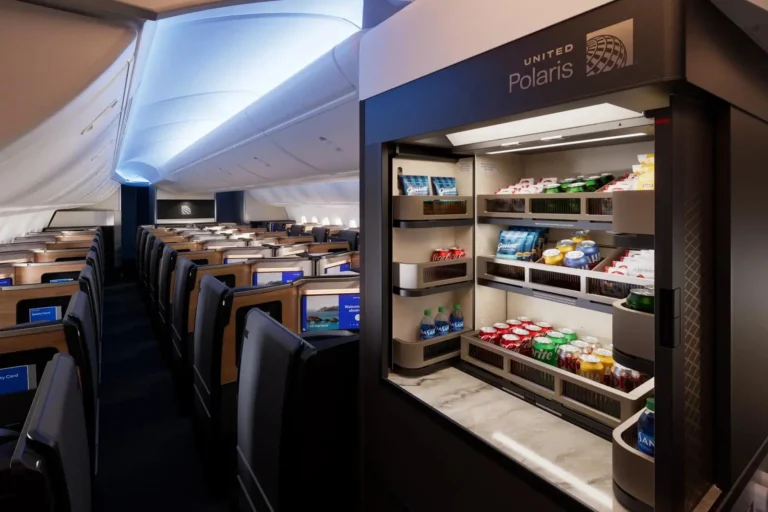
At the premium end, both airlines have invested significantly in their flagship products. Delta One Suites available on most widebody international routes feature full lie-flat beds, sliding privacy doors, and direct aisle access. United Polaris, introduced a few years earlier, also delivers lie-flat beds with strong bedding and a dedicated Polaris lounge experience at key hubs.
Frequent premium flyers tend to rate both products similarly. The Delta One experience edges ahead slightly in terms of cabin crew service ratings, while United Polaris lounges in New York, Chicago, Los Angeles, Houston, and San Francisco are considered among the best airline lounges in the U.S. If lounge access matters to you, United Polaris Lounges are a genuine differentiator.
Frequent Flyer Programs: MileagePlus vs SkyMiles
United’s MileagePlus is widely considered the stronger loyalty program for savvy travelers in 2026. Miles don’t expire as long as you have account activity, and MileagePlus miles can be redeemed at strong value rates on partner airlines including Singapore Airlines Suites, which represents one of the best redemption values in the world at 95,000 miles for a round-trip business class ticket.
Delta SkyMiles, on the other hand, has faced criticism for removing award charts in 2023 and introducing fully dynamic pricing for award tickets. This means the cost in miles for any given seat can fluctuate unpredictably. While Delta’s program is still useful for casual flyers, serious miles collectors find it harder to maximize value compared to MileagePlus.
Delta’s co-branded credit cards particularly the Delta SkyMiles® Reserve American Express Card remain popular for earning miles on everyday spending. United’s Chase co-branded cards, especially the United Explorer Card and United Club Infinite Card, are similarly competitive. Both programs offer solid credit card ecosystems, but MileagePlus holds the edge for international premium cabin redemptions.
Fees and Pricing: What You’ll Actually Pay
Both Delta and United charge $35 for the first checked bag and $45 for the second on most domestic economy fares as of 2026. Neither airline includes free bags with basic economy tickets unless you hold a co-branded credit card. This pricing parity makes fees a non-factor when choosing between the two carriers.
Where Delta wins on fees is in its Basic Economy restrictions. United’s Basic Economy product is more restrictive passengers cannot bring a full-size carry-on bag and are among the last to board. Delta’s Basic Economy, while still limited, allows one free personal item and is slightly more flexible in how it handles upgrades and seat assignments.
On base ticket pricing, the difference between the two airlines on any given route tends to be minimal usually within $20–$40 on comparable fares. Neither airline consistently undercuts the other. Your best bet is always to compare prices directly on Google Flights or the airline’s own site for your specific travel dates and route.
Customer Service: Delta’s Reputation for Handling Problems
Delta ranked #1 among traditional network carriers in the J.D. Power 2025 North America Airline Satisfaction Study, while United came in third. This gap reflects years of intentional investment in customer service training improved complaint resolution processes at Delta. Passengers report that Delta’s agents both at the airport and over the phone are generally more empowered to resolve issues on the spot.
During irregular operations like weather delays or mechanical issues, Delta’s rebooking speed and proactive communication are consistently praised. The Fly Delta app sends real-time updates, alternative flight options, and hotel voucher links faster than most competitors, including United. United has improved its app experience significantly in 2025 with an AI-powered rebooking assistant, but Delta still holds the edge in overall execution.
United has invested heavily in customer experience improvements following high-profile incidents in the past decade. Its “Good Leads the Way” service initiative, launched in 2023 and still active in 2026, has driven measurable improvements in cabin crew ratings. The gap between the two airlines has narrowed, but Delta remains the leader.
Which Airline Is Better for Specific Traveler Types?
Best for Business Travelers
Delta is the better choice for domestic business travel. Its reliability, Comfort+ product, Sky Club lounges, and Medallion elite status program create a consistently premium experience. For international business travel, United’s broader route network and superior MileagePlus program may tip the scales in its favor.
Best for Budget Travelers
Neither airline is a budget carrier, but Delta’s slightly more flexible Basic Economy fare makes it the better pick if you’re trying to stretch a dollar without getting hit with hidden restrictions. Always compare both airlines on your specific route before booking pricing varies significantly by market.
Best for Families
Delta edges ahead for families thanks to its more reliable schedule and more lenient carry-on policies in Basic Economy. Families with young children especially benefit from Delta’s consistent on-time performance fewer delays means fewer meltdowns in the terminal.
Best for International Travelers
United is the better airline for travelers with complex international itineraries, thanks to its larger route network and Star Alliance partnerships. If you’re flying to Asia, the Middle East, or anywhere that requires multiple airline connections, United’s network provides more seamless options
Best for Frequent Flyers and Points Enthusiasts
United MileagePlus wins here. The program’s transparency, partner redemption opportunities, and lack of mile expiration make it more rewarding for travelers who pay close attention to loyalty program strategy.
Frequently Asked Questions: Delta vs United Airlines
Is Delta or United better for domestic flights?
Delta is generally better for domestic flights in 2026. Its on-time rate of 84.2% outpaces United’s 79.1%, its in-flight experience is more consistent, and its customer service ratings rank higher. For routes out of United’s key hubs Chicago, Houston, or Denver United may be the more practical choice due to route frequency.
Which airline has better international routes, Delta or United?
United has a larger international network with approximately 370 destinations compared to Delta’s 330. United’s Star Alliance membership also gives access to more global partner airlines, making it the stronger choice for complex international itineraries.
Which frequent flyer program is better SkyMiles or MileagePlus?
United MileagePlus is the stronger program for most frequent flyers in 2026. Miles don’t expire with account activity, award charts are more transparent, and partner redemption values particularly on premium international cabins are significantly better than Delta’s dynamic-pricing SkyMiles model.
Does Delta or United have better business class?
Both Delta One and United Polaris are excellent business class products with lie-flat beds and strong service. Delta One Suites edge ahead slightly in cabin crew service ratings, while United Polaris Lounges are considered among the best airport lounges in the U.S. It’s essentially a tie at the premium level.
Which airline is cheaper, Delta or United?
Neither airline is consistently cheaper than the other. Both charge the same baggage fees ($35 for the first checked bag) and price their tickets competitively on most routes. Always compare both on Google Flights for your specific dates and destination before booking.
Which airline has better Wi-Fi, Delta or United?
Delta has slightly better Wi-Fi coverage, available on approximately 85% of its mainline fleet in 2026 compared to United’s roughly 80%. Delta’s Wi-Fi plans are also available in a broader range of packages, including free basic messaging on some routes for SkyMiles members.
Is Delta safer than United Airlines?
Both Delta and United maintain excellent safety records and are certified by the FAA to the same standards. Neither airline is objectively “safer” than the other. Commercial aviation remains the safest form of long-distance travel, and both carriers consistently pass all required safety audits.
Which airline is better for flying with kids?
Delta is generally the better option for families with children. Its higher on-time rate reduces the stress of long layovers, its Basic Economy fare is slightly less restrictive, and its overall customer service ratings mean issues are resolved faster when they arise.
Final Verdict: Which Airline Should You Choose?
After comparing on-time performance, route networks, in-flight experience, loyalty programs, fees, and customer service, Delta Air Lines is the better airline for most travelers in 2026. It is more reliable, more consistently comfortable, and better at resolving problems when things go wrong. For the average traveler whether a business flyer, a family, or an occasional vacationer Delta delivers a stronger overall experience.
That said, United Airlines is the right choice in several specific scenarios: if you’re a miles enthusiast who wants to maximize MileagePlus redemptions, if you frequently fly international routes where United’s network or Star Alliance partnerships give you more options, or if you live near a United hub like Chicago O’Hare, Houston Bush Intercontinental, or Denver International.
The smartest approach in 2026 is to pick your primary airline based on your home airport and most frequent routes, then build loyalty in that airline’s program. For most people in the eastern U.S. and Southeast, Delta is the clear answer. For travelers in the Midwest, Mountain West, or those who fly Pacific international routes regularly, United deserves serious consideration. Compare both on your next specific route and let the combination of price, schedule, and program loyalty guide the final decision.
About the Author
This article was written by our senior travel and aviation editorial team, which includes writers with over 15 years of combined experience covering commercial aviation, airline loyalty programs, and consumer travel. Our team has collectively flown more than 2 million miles across both Delta and United’s networks, tested business class products on both carriers, and regularly analyzes Bureau of Transportation Statistics data, J.D. Power airline satisfaction surveys, and industry reports to ensure our comparisons reflect real-world passenger experience. Content is reviewed annually and updated to reflect current airline performance, pricing, and program changes.