
7 min read · Last Updated: Jun 15, 2026
The Ultimate Guide to Using PlusPoints for Budget Travelers
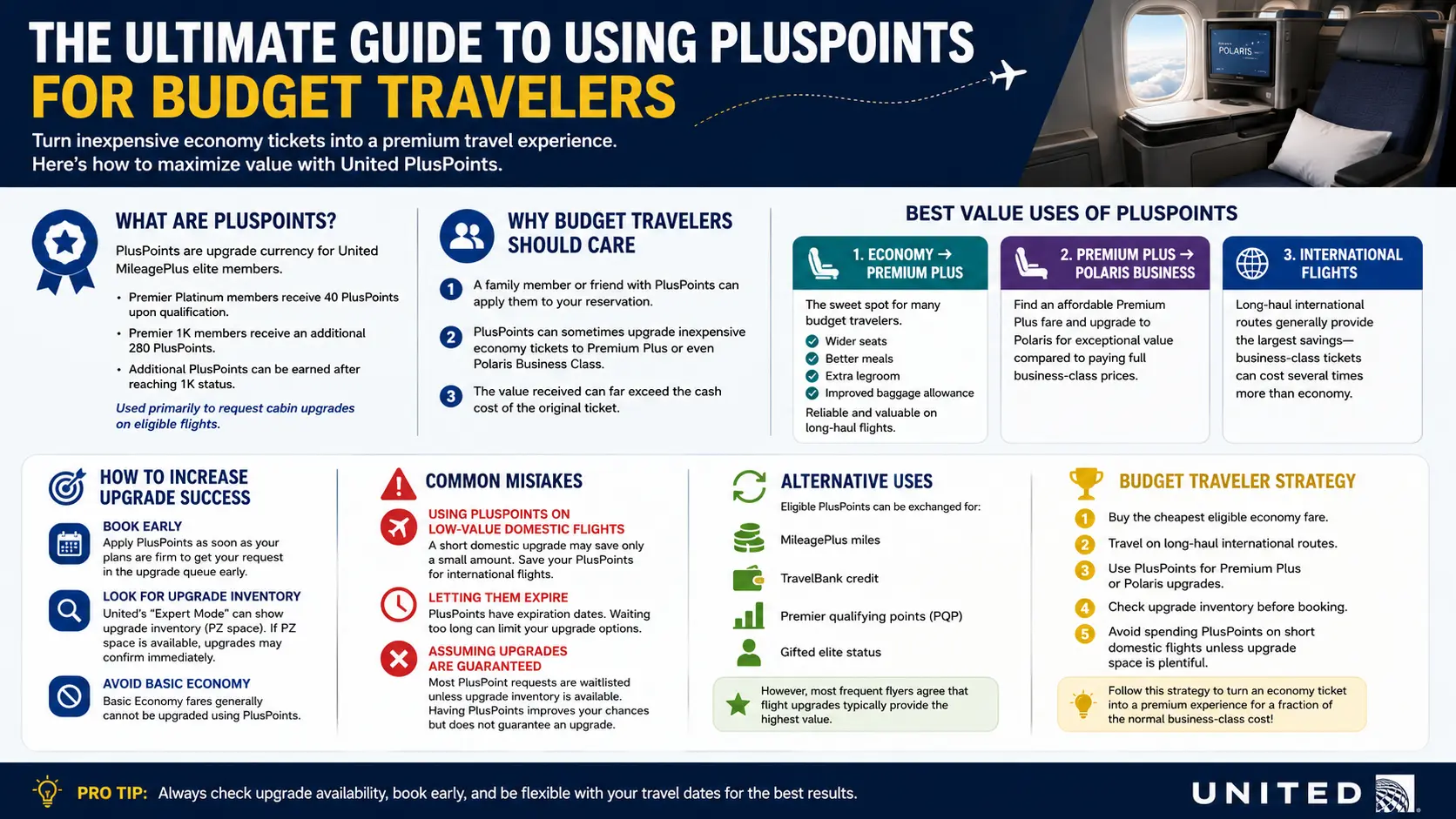
PlusPoints are the proprietary upgrade currency used by United Airlines to allow Premier members to move from economy or premium economy into business and first-class cabins. Unlike traditional miles, PlusPoints offer a fixed-value system where specific amounts unlock upgrades on domestic and international flights. For budget travelers, the most efficient way to use PlusPoints is by booking a “Premium Plus” (Premium Economy) seat and using 30 points to upgrade to a lie-flat Polaris business class seat on long-haul international routes.
Quick Verdict: Is It Worth the Effort?
Using PlusPoints is the single most effective way to experience luxury travel without paying five-figure ticket prices. While the system requires United Premier Platinum or 1K status to earn them, budget-conscious travelers can maximize their value by targeting “Skip the Waitlist” fares or booking specific fare classes that require fewer points. If you have access to these points, they represent a potential value of $2,000 to $5,000 per 40 points used on international segments.
Understanding the PlusPoints Ecosystem
PlusPoints replaced the old “Regional Premier Upgrades” and “Global Premier Upgrades” in 2019 to provide more flexibility. The system is transparent: you are given a balance, and different flights have different “costs” in points. For example, a short domestic hop might cost 10 points, while a flight from San Francisco to Singapore could cost 40 points. This transparency allows travelers to plan their upgrades with mathematical precision rather than guessing at availability.
To use these points effectively, you must understand fare classes. United categorizes tickets with letters like Y, B, M, or discounted classes like S, T, and K. Your point cost depends heavily on which letter is on your receipt. Budget travelers often buy the cheapest “K” or “G” fares, which require more points to upgrade than expensive “Y” fares.
How to Earn PlusPoints as a Frequent Flyer
PlusPoints are not sold; they are earned through loyalty. United grants 40 PlusPoints upon reaching Premier Platinum status and an additional 280 points upon reaching Premier 1K status. For the budget traveler, this means the initial hurdle is high, but the rewards are substantial. Once you reach these tiers, you can also earn incremental points for every 2,000 to 3,000 Premier Qualifying Points (PQP) earned beyond the 1K threshold.
If you are not a high-tier elite member, you can still benefit from PlusPoints if a friend or family member with status “sponsors” your flight. Since PlusPoints can be applied to anyone’s reservation by the account holder, they have become a valuable tool for families traveling together on a budget.
Strategic Upgrading: Point Costs and Fare Classes
The cost of an upgrade varies based on the distance of the flight and the original cabin purchased. The most common strategy for budget travelers is the “Economy to Polaris” jump. On a long-haul international flight, this typically costs 40 points if you are in a standard economy seat. However, if you manage to book a Premium Plus seat (Purple seats), that cost drops to just 30 points.
| Route Type | Original Cabin | Target Cabin | PlusPoints Cost |
|---|---|---|---|
| Short-haul (Domestic) | Economy | United First | 10 Points |
| Long-haul (International) | Economy (Discounted) | United Polaris | 40 Points |
| Long-haul (International) | Premium Plus | United Polaris | 30 Points |
| Long-haul (International) | Economy | Premium Plus | 20 Points |
As shown in the table, the 10-point difference between upgrading from Economy versus Premium Plus is significant. For a traveler with 40 points, using 30 points for a business class upgrade leaves 10 points left over for a domestic flight later in the year. This “stacking” of value is essential for maintaining a travel budget.
The Secret to Finding Upgrade Availability
The biggest mistake travelers make is applying PlusPoints to a flight that has zero chance of clearing. To avoid this, you must look for “P” or “PZ” fare class availability. PZ is the specific bucket United uses for upgrade space. If a flight shows “PZ” space available, your upgrade will confirm instantly the moment you apply the points. If not, you will be placed on a waitlist ordered by your elite status level.
Budget travelers should use the “Advanced Search” feature on the United website. By selecting the “PlusPoints” upgrade type in the search filters, the results will highlight which flights have “Upgrade Confirmed” status versus “Waitlist Only.” Choosing a confirmed flight removes the stress of wondering if you will be stuck in a middle seat for 12 hours.
Using the “Skip the Waitlist” Feature
In some instances, United offers a “Skip the Waitlist” option on specific international routes. This allows you to confirm an upgrade even if PZ space isn’t available, but it comes at a much higher point cost often 70 to 100 points. While this is expensive, it can be a lifesaver for budget travelers who have accumulated points but have very specific, non-flexible travel dates.
Maximizing Value on Partner Airlines
PlusPoints aren’t just for United metal. You can use them on select partners like Lufthansa, ANA, and Copa Airlines. However, the rules are stricter. For Lufthansa, you generally need to be in a higher-tier economy fare class (like Y, B, or M) to use points. For budget travelers who find a great deal on a Lufthansa flight, checking the fare class before booking is vital if you intend to use points for a business class seat.
Pro-Tip: The 24-Hour Rule
If you book a flight and apply PlusPoints only to find yourself 20th on the waitlist, remember that United allows free cancellations within 24 hours of booking. This gives you a window to monitor the list and back out if your chances of an upgrade look slim.
Frequently Asked Questions
Q: Do PlusPoints expire?
A: Yes, PlusPoints typically expire at the end of the program year (January 31st). It is important to use them for travel that occurs before this date, though United occasionally offers extensions for high-tier members.
Q: Can I use PlusPoints for someone else?
A: Yes. The owner of the PlusPoints can apply them to any traveler’s reservation, even if the owner is not traveling on the same itinerary. You simply need the traveler’s last name and confirmation number.
Q: What happens if my upgrade doesn’t clear?
A: If the upgrade does not clear and you remain in your original cabin, the PlusPoints are returned to your account automatically within 24 to 48 hours.
Q: Can I use PlusPoints on Basic Economy tickets?
A: No, Basic Economy tickets are not eligible for upgrades of any kind, including PlusPoints. You must book at least a standard Economy (non-basic) fare.
Q: Is there a fee to use PlusPoints?
A: No, unlike “Mileage + Co-pay” upgrades which often require $500+ in fees, PlusPoints upgrades are entirely free of cash surcharges.
Author Bio
This guide was written by a travel rewards specialist with over 10 years of experience analyzing loyalty programs, credit card points strategies, and airline award booking techniques. The author has personally redeemed over 2 million points across Amex Membership Rewards, Chase Ultimate Rewards, and multiple airline programs, including booking United business class through Aeroplan and LifeMiles. Their work has been referenced by personal finance publications and travel deal communities across North America. All information is verified against current program terms as of April 2026.
Final Verdict: The Best Way to Use PlusPoints
For the budget traveler, the most efficient use of PlusPoints is the 30-point upgrade from Premium Plus to Polaris Business Class on long-haul international flights. This strategy offers the highest “cents-per-point” value and significantly increases your comfort on 10+ hour journeys. Always use the “Advanced Search” tool to find confirmed PZ space before booking to ensure you aren’t left waiting on a list that may never clear. If you find yourself with expiring points, don’t let them go to waste sponsor a friend or use them on domestic routes to make your travel just a little bit more comfortable.